Monday, September 26, 2011

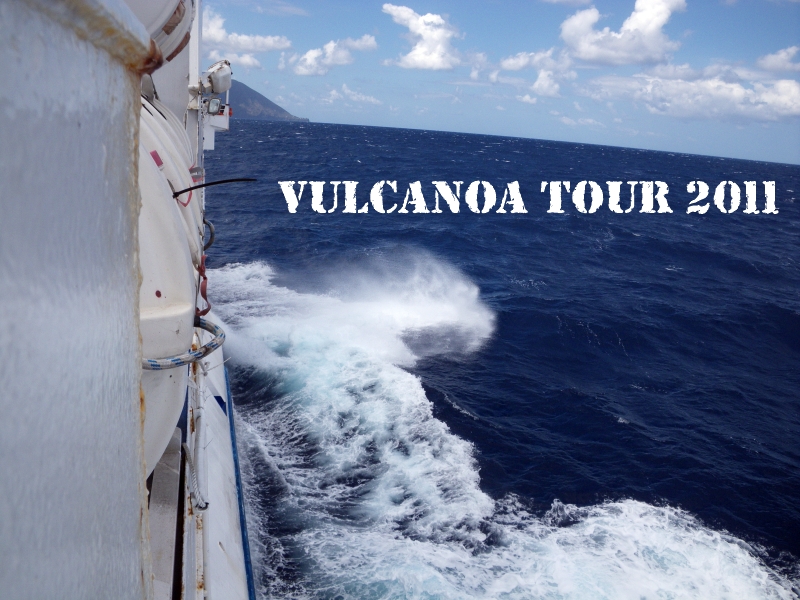
Vulcanoa Tour - Plans are changed!

The very bad weather forecast discouraged many participants to engage themselves on the tour around western Aeolian Islands and on monday 19th only seventeen paddlers are present in Vulcano. The Coast Guard call to say that they didn't give the permission for the crossings to Filicudi and Alicudi islands, so the plans need some changes.


 Winds blow from WNW up to 20-25 knots. Offshore waves are 3 meters high and hit the west coast of Vulcano island, coming from the far distance of Sardinian sea, where the gale has Force 9. The only safe possibility is to paddle on the lee of the island, maintaing the group very close to the coast, and it is what we decide to do on the first day of the gathering. The reinforcing of the wind in the afternoon adds some adrenaline both to participants and guides when, on the way back to the Porto di Levante cove, the group struggle against a strong current and gusts of wind at Punta Lùccia: all the guides and helpers are involved in towing, rescuing of capsized paddlers and kayakers unable to keep the bow into the wind. Fortunately we don't had to call for a rescue to the Coast Guard, but we were pretty close to this evenience and the group was back on land, just in time to avoid a tunderstorm with lightening and even stronger gusts of wind.


 The weather deteriorated, ferries failed to connect the islands to the mainland, except one that was navigating in the lee sides of Salina, Lipari and Vulcano to maintain a minimum of the service. We loaded kayaks and gear on this one and reached Salina, to find one of the best accomodation of theese islands, in a family residence in which we were able to prepare our food all togheter and have beautiful dinners.
The following day the wind slowed down to 10 knots and, despite the sea state was still rough, we launched for the circumnavigation of the island. An "early" start, at 9 'o clock, give us the possibility to paddle all the way around in the day, with the last stop in Lingua for the usual refreshing granita of the Alfredo bar. At the end of the day, we have a super-dinner under the direction of Dario.


The weather now is again the very sicilian summer. We make the 4 km crossing to the west coast of Lipari, with its rock cliffs, caves, stacks, blue cristalline waters and small pebbles beaches. We spent a lot of time exploring and rock gardening along the coast. After we cross to Vulcano and the group split in two parts, one of which go to visit the Cavallo cave on the west coast of the island. The end of the gathering is celebrated in the Stevenson pub and we let run te hours and the pints.
Even this time, the changed plans turned to be a good option.

Many thanks to all the instructors and guides that make this event possible!

Tuesday, August 30, 2011

A paddling week in Sweden

At the end of August I was invited by Mikael and Johan to hold courses on rescue and rolling in Sweden. Their Maremotu base is located in Billdal, a lovely small village south of Goteborg. Despite the season was at its end the weather was beautiful, with sunny days and agreable temperature. For me, coming from the 38°C of Sicily, it was a great relief to feel the 20°C of the Goteborg City airport.

The warm welcome of my guests' families was the one you can receive from old friends. I was like at home from the first instant and Mikael and Johan provided me fantastic paddling days despite a cold, a broken car (for the two of them), children at school and their own work as teachers.
The Billdal beach have a floating pier that is perfect for students to follow the explanation of the instructors in 1 meter deep water. Here, during the afternoon of the first day we did some exercise, to improve the greenland standard roll. Then a gorgeous dinner was ready at Mikael's home!


 In the following days we paddled around the lovely archipelago, rockhopping from an island to the other, crossing safely the short distances and leaded by Mikael and Johan that know this place like their own pockets.
The wildlife is wonderful, swans, sea gulls, herons, cormorants and seals were just some of our encounters. In some islands it is possible to camp and it was a shame that I did not have the time to stay longer.

 One day in the city and one morning bycicling around Billdal has been my only activity out of the water.
The last day we had a group of paddlers that followed a base course with rescues. It was a rainy day but we were into the water anyway, so nobody complained for the weather and all went well, including a delicious pasta cooked by Mikael under a large tree.
The last dinner, at Johan's home was nice and relaxing, and it was a bit heavy to say "ciao" and to leave on the next morning. 
We are now altogheter planning a paddling week around the archipelago for 2012, probably between June and July, so... stay tuned! 

Tuesday, June 28, 2011

Kayak For Cancer. Malta - Catania.

La rotta percorsa.
The 26th June 2011, four crews, two Maltese, one from Rome and one from Catania, reached the base of Circolo Canoa Catania in four hard days at sea, starting from Malta. The already-oiled organization led by Dorian Vassallo and Albert Gambina, who are now at their fifth adventure of this kind, for this year proposed a route Malta-Catania-Avola-Sampieri. 
Dorian Vassallo & Albert Gambina.
Due to the rough seas encountered in Jonian Sea they had to add a stop in Syracuse, but remains unchanged the challenge to paddle for 125 nautical miles. Without any support boat for assistance, even during the dangerous open sea crossing of the 50 nautical miles in the Sicily Strait!
Fabrizio Messina, on a double kayak with Francesco Landolina, told us about the difficulty of the last 10 miles of the crossing, an encounter with the dolphins, the ups and downs in mood and energy, the arrival in Sicily in the dark, the rough waters approaching Syracuse...
The faster crew was composed by Gianni Montagner and Betty Bassanelli from Rome, with a Outrigger Canoe tandem, well trained in other open sea crossings, both in the Mediterranean Sea and in the Ocean.

Il Team in polinesiana doppio/misto di Tulku Canoa Roma.
Our heroes from Malta, aboard two double kayaks, organized this event to raise funds for cancer research in children, naming the challenge "Kayak for Cancer".
Fabrizio, the day after his arrival in Catania, wrote this text on Facebook: "Everyone should do something of great and fight not only for themselves! Now is time to rest :-)))".

_________________________________________________
Il 26 Giugno 2011, quattro equipaggi, di cui due maltesi, uno catanese ed uno romano, hanno raggiunto Catania in quattro duri giorni di mare, partendo da Malta. La già rodata organizzazione capitanata dagli amici Dorian Vassallo e Albert Gambina, che ormai sono alla loro quinta avventure di questo genere, ha proposto per quest'anno il percorso Malta-Sampieri-Avola-Catania. Per il mare grosso incontrato sullo Jonio hanno dovuto aggiungere una tappa a Siracusa ma resta invariata la percorrenza di ben 125 miglia nautiche, senza alcuna barca di assistenza, anche per la traversata dello Stretto di Sicilia di quasi 50 miglia nautiche!

Mark Bugeja & Mike Gellel.
Fabrizio Messina (Circolo Canoa Catania), in kayak biposto con Francesco Landolina, ci ha raccontato la difficoltà delle ultime 10 miglia, dell'incontro con i delfini, degli alti e bassi di umore e di energia, dell'arrivo con il buio in Sicilia...
L'equipaggio catanese Landolina - Messina.
Quello di Gianni Montagner, su polinesiana biposto insieme a Betty Bassanelli, era l'equipaggio più veloce, ben rodato su altre traversate, sia in Mediterraneo che in Oceano.
I nostri eroi di Malta, a bordo di due kayak biposto, hanno organizzato questo evento per raccogliere fondi da devolvere per la ricerca sui tumori nei bambini, intitolando l'impresa "Kayak for Cancer".
Fabrizio, il giorno dopo il suo arrivo, ha riportato questo sul suo profilo Facebook: "Che tutti facciano qualcosa di grande e lottino non solo per se stessi!! Ora riposo :-)))"
Fabrizio addenta voracemente una meritata cipollina!

Wednesday, May 18, 2011

Ustica Island

Ferry landing in Ustica.

Maybe not many people know that Ustica Island is just the summit of an ancient volcano that rises from a 2000 meters deep seafloor. Located 35 miles offshore, north of Palermo, it tooks few hours with the ferry to get there.
Lunch at La Cernia Bruna.

Grotte del Lapillo (cave).
Hut of Mt. Guardia dei Turchi.

The downhill.
The view of the village
from Mt. Guardia dei Turchi.

The first day of our weekend on the island is dedicated to a short exploration of the center of the island, with the climbing to the top of Mt. Guardia dei Turchi. From the top of the extinct crater the view cover the entire island perimeter, including the large flat area on the north side, with the remains of a Bronze Age prehistoric village. 
On the way down we pass the Lapillo Cave, an old pumice mine and than straight to a pizzeria.
Clockwise circumnavigation.

A view of the little harbour.


Sunday morning weather forecasts give winds picking up from south-west in the afternoon. Our choice is to explore the south coastline and the marine caves in the morning, to be safe and happy on the north side at the time the wind will blow hard.
We get at the southwesternmost tip of the island just at the start of the wind and some big waves are already formed, enough to require an accurate route for a safe enter into the small rocky bay under the lighthouse, avoiding rocks and breakers.

 On the north coastline we enjoyed the flat and ultra-clear waters, paddling very close to the rocky shore and visiting three more caves in the vicinity of the prehistoric village. Only the last 500 meters were a bit exposed to the SW wind, now blowing at 15 knots, but even the beginners were able to slowly manage this last effort.
 
 Offshore the sea was between force 3 and 4 and the ferry was shaken by the waves on his way back to Palermo on the mainland. Now we know that the following day the ferry did not faced the rough sea for the increased wind force: this precarious connection to the mainland contribute to save the charme of a true, isolated island.